Immortal and Indefensible: The Strange, Stubborn Afterlife of Candy Corn
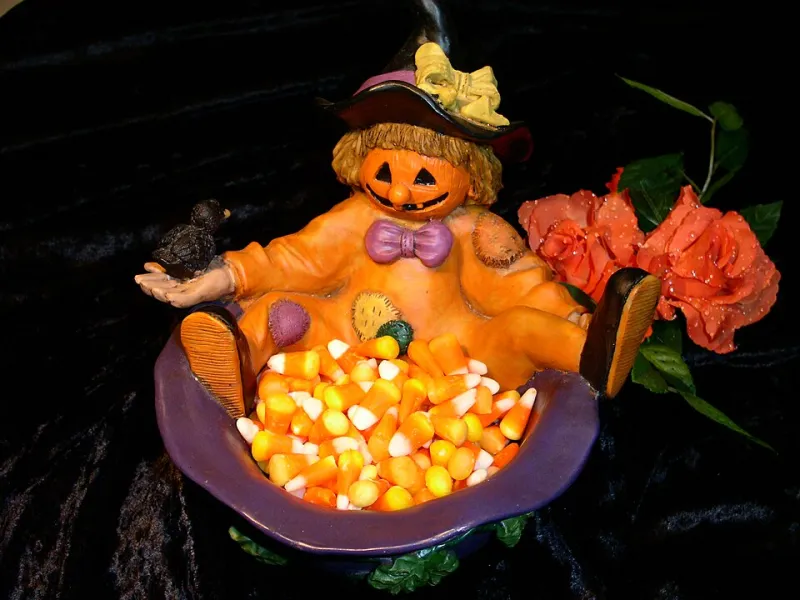
Photo: Toyah Anette B, Public domain, via Wikimedia Commons
Every October, a ritual plays out across America with the reliability of a full moon. Someone — a coworker, a family member, a stranger on Twitter who has done nothing wrong — puts out a bowl of candy corn. And within minutes, the discourse begins. "It tastes like sweetened candle wax." "Who even eats this?" "This is a hate crime."
And yet.
And yet.
The National Confectioners Association estimates that roughly 35 million pounds of candy corn are produced annually in the United States. That's not a rounding error. That's not a factory accident. Someone — tens of millions of someones — is buying, consuming, and presumably enjoying a candy that the entire internet has agreed to despise for going on three decades. This is either a massive psychological mystery or the greatest long con in American snack food history.
Welcome to the Candy Corn Conspiracy. Population: all of us, whether we admit it or not.
A Brief, Weird History of a Weird Little Candy
Candy corn is genuinely old. Like, disturbingly old for something still sold in plastic pumpkin buckets at CVS. The candy is generally credited to George Renninger of the Wunderle Candy Company in Philadelphia, who invented it sometime in the 1880s. The Goelitz Confectionery Company — now known as Jelly Belly, which tells you something about the glow-up potential of candy brands — began mass producing it in the early 1900s.
At the time, the corn-shaped design was considered charming and novel. Candy shaped like vegetables! What a time to be alive. It was originally called "Chicken Feed" and marketed to an agricultural nation that apparently found farm imagery in its desserts aspirational rather than confusing.
For most of the early twentieth century, candy corn wasn't even specifically a Halloween candy. It was a general autumn treat, available from roughly August through November. Its association with Halloween solidified gradually through the mid-century, helped along by the rise of trick-or-treating culture in postwar suburban America. By the 1970s and '80s, it had become so thoroughly coded as a Halloween item that its entire annual identity collapsed into a single month.
This is, as we'll discuss, both its greatest curse and its most powerful marketing asset.
The Hate-Buying Phenomenon
Here's where the psychology gets genuinely interesting. Multiple candy industry analysts and consumer behavior researchers have noted a pattern with candy corn that doesn't show up with almost any other product: people who claim to dislike it continue to purchase it in significant numbers.
Why? The theories are surprisingly compelling.
First, there's what we might call the nostalgia tax. Candy corn tastes like Halloween. Not like good Halloween, necessarily — not like a Reese's Peanut Butter Cup or a Snickers, both of which are objectively superior candies by nearly every measurable metric. But candy corn tastes like the idea of Halloween. The orange and yellow and white of it, the waxy resistance before it yields, the sugar hit that's somehow both too much and not enough — these things are encoded in the memory of anyone who grew up trick-or-treating in America. Buying candy corn isn't really about candy corn. It's about buying access to a feeling.
Second, there's the social performance angle. Complaining about candy corn has become a Halloween tradition in its own right. The complaint requires the candy's presence. You cannot dramatically hold up a candy corn and announce your displeasure to a roomful of people if there's no candy corn to hold up. The candy has become a prop in a recurring cultural comedy sketch, and someone has to keep buying the props.
"I genuinely don't like it," admits Terrence, a 44-year-old accountant from Columbus, Ohio, who nonetheless buys a bag every October. "But I buy it because it's October. It would feel wrong not to. It's like buying a Christmas tree even though pine needles get everywhere and the cat drinks the water."
The Defense Rests (Sort Of)
In the interest of journalistic fairness — and because ScreamOWeen believes in giving a voice even to the genuinely unhinged — we should note that candy corn does have actual defenders. Real ones. People who will look you in the eye and say they like it.
"People who hate candy corn are eating it wrong," insists Donna, a Halloween enthusiast from suburban Dallas who requested we use only her first name (presumably to protect herself from online harassment, which is a completely reasonable concern). "You're not supposed to eat a whole handful. You eat one, maybe two, and you let them melt a little. It's a slow candy. People treat it like M&Ms and then act surprised that it's overwhelming."
Donna has a point, and it's an uncomfortable one. Candy corn eaten slowly, in small quantities, is a genuinely different experience than the fistful approach most critics employ. Is it a great candy? No. Is it interesting? Weirdly, yes. The flavor — a blend of sugar, corn syrup, carnauba wax (yes, the same stuff used in car polish, and yes, that's fine), and artificial vanilla — is distinct in a way that few modern candies are. In an era of extreme candy innovation, candy corn is defiantly, almost aggressively itself.
The Marketing Genius Nobody Talks About
Here's the part of the candy corn story that deserves genuine respect: whoever decided to keep this candy permanently tethered to Halloween made one of the smartest branding decisions in American confectionery history.
By existing only in October, candy corn generates scarcity psychology without actually being scarce. Its annual disappearance from shelves makes people nostalgic for it in September. Its return to shelves in October feels like an event. It anchors itself to an emotional holiday in a way that, say, a bag of plain hard candies never could.
Compare this to, for example, candy that's available year-round and struggles to maintain seasonal relevance. Candy corn doesn't have that problem. It is the season. Remove candy corn from Halloween and something genuinely feels missing — not because the candy is beloved, but because it has successfully embedded itself into the architecture of the holiday itself.
That's not an accident. That's decades of consistent brand positioning so effective that even its haters do its marketing for free every single October.
What Candy Corn Actually Is
At its core, candy corn is a Rorschach test for how Americans relate to tradition, nostalgia, and the particular comfort of hating something familiar.
It's bad, probably. It's also irreplaceable, definitely. It's the Halloween equivalent of that one relative who shows up to every Thanksgiving, says something mildly offensive, eats too much, and leaves — and yet the holiday would feel hollow without them.
So go ahead. Buy the bag. Complain loudly about it. Eat three pieces while complaining. Leave the rest in a bowl on your counter until December.
Candy corn will be back next year. It always is. It was here before you started dunking on it online, and it will be here long after the discourse has moved on to the next seasonal atrocity.
Some things are simply immortal. Not because they deserve to be. Just because they refuse to go.