Dressed to Kill: How Horror's Greatest Villains Became Fashion Icons of Fear
Here's something nobody talks about at Halloween parties: horror villains are, almost universally, better dressed than the people they're hunting. Think about it. Ghostface glides through Woodsboro in a sleek black robe and a mask that somehow reads as both theatrical and genuinely unsettling. Meanwhile, his victims are shuffling around in oversized college sweatshirts and pajamas. Michael Myers has worn essentially the same outfit for nearly five decades and it still works. The Babadook looks like he walked out of a German Expressionist fashion shoot.
This isn't an accident. Costume designers working in horror carry one of the heaviest responsibilities in the genre — they have to make you afraid of a piece of fabric before the character even moves.
The Psychology Behind the Palette
Color theory is a huge part of why villain costumes land so hard. Horror designers lean on a surprisingly narrow palette — black, white, grey, and occasionally a brutally specific shade of something else (looking at you, Pennywise's red balloons and yellow jumpsuit). These choices strip away the visual noise of everyday life and create something that feels wrong in a very specific way.
Michael Myers is the gold standard here. His coveralls are a dull, institutional grey-blue — the color of nothing, of nobody. Combined with that bleached William Shatner mask, the whole look communicates a total absence of personality, which is precisely what makes him so disturbing. There's no ego in the outfit. No vanity. Just function. Costume designer Deborah Nadoolman Landis (who worked on the original Halloween) understood that Myers needed to look like a void wearing clothes.
Contrast that with Freddy Krueger, who is basically the opposite philosophy executed just as brilliantly. Freddy's striped sweater, battered fedora, and dirty brown pants are garish and specific — the wardrobe of a man who wants to be seen, who takes pleasure in being recognized. The visual cacophony of those red and green stripes is almost nauseating up close, which is absolutely the point. Freddy's clothes say: I'm not hiding. I'm the nightmare you can't look away from.
What Victims Wear (And Why It Matters)
Pull up any slasher from the '80s and check what the victims are wearing. Jeans. T-shirts. Cheerleading uniforms. Normal clothes — which is, again, intentional. The ordinariness of victim costuming serves a dual purpose: it grounds the audience in a relatable reality, and it makes the villain's silhouette pop against that backdrop like a shark fin in a kiddie pool.
When Sidney Prescott faces off against Ghostface, she's usually in something completely unremarkable. That visual contrast isn't just aesthetic — it's a power dynamic written in fabric. The villain's costume signals preparation, identity, and intention. The victim's clothes signal vulnerability, normalcy, and the life they had before the story started.
This is why the reveal in Silence of the Lambs that Hannibal Lecter's most terrifying look isn't his prison jumpsuit but his escape suit — the stolen guard's uniform, worn with that terrifying composure — hits so hard. He's taken the costume of authority and made it his own. The visual language flips entirely.
The Mask as Character
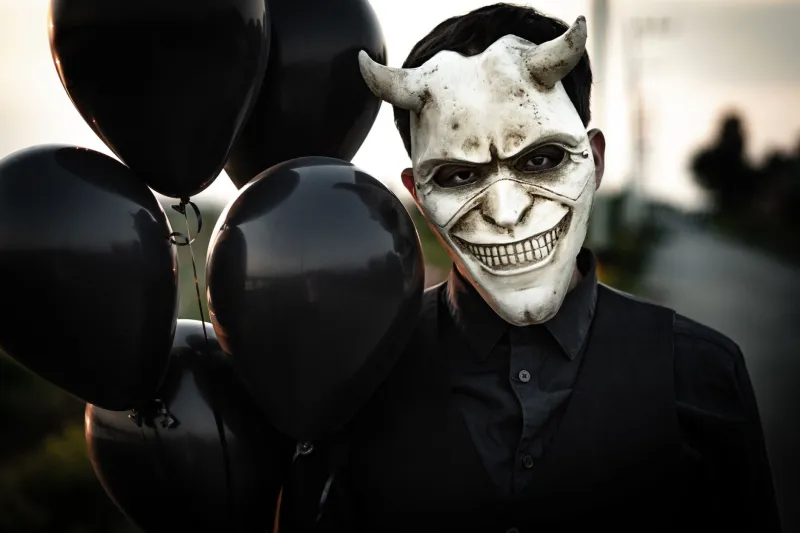
No conversation about horror villain fashion survives without addressing masks, which deserve their own PhD dissertation. The mask is the ultimate costume shortcut — it removes the human face and replaces it with something the brain can't quite process correctly.
Leatherface's patchwork human-skin mask from The Texas Chain Saw Massacre is grotesque precisely because it's a failed attempt at normalcy. It's a face that wants to be a face. Jason Voorhees' hockey mask, introduced in Friday the 13th Part III, became so iconic that it essentially replaced Jason's identity entirely — generations of fans couldn't tell you what Jason's actual face looks like, and that's the point.
The Ghostface mask from Scream works differently. It's theatrical, almost cartoonish — a Halloween store item that characters in the movie would recognize as a Halloween store item. That self-awareness is baked into the costume design. It's a mask about masks, which is very on-brand for a franchise about horror movie tropes.
When Costume Design Becomes Cultural Shorthand
The true measure of a successful horror villain costume is how quickly it detaches from the source material and becomes a symbol. Michael Myers' coveralls and mask are so culturally embedded that a kid wearing them trick-or-treating doesn't need to have seen a single Halloween film for the costume to register as threatening. The design has done its job so completely that it now exists independently.
Costume designers in the horror space have to think about this legacy dimension in a way that, say, romantic comedy wardrobe departments don't. They're not just dressing a character for one film — they're potentially designing a cultural icon that will appear on millions of Spirit Halloween racks for the next half-century.
What Modern Horror Is Learning
Contemporary horror has gotten increasingly sophisticated about this visual language. The Babadook's top hat and tattered suit pull from Victorian mourning dress, creating a villain who looks like grief given physical form — which is exactly what he is. Art Clown from the Terrifier franchise takes the clown archetype and strips it down to something almost brutalist: black and white, no color, maximum contrast. It's been enormously effective.
Even elevated horror films like Hereditary and Midsommar understand this principle. The white ritual garments in Midsommar are terrifying precisely because they're beautiful — pristine, floral, and deeply wrong in context. Director Ari Aster and costume designer Andrea Flesch used the visual language of innocence to signal something much darker underneath.
The lesson horror keeps teaching is that what a villain wears isn't decoration — it's exposition, psychology, and threat assessment all rolled into one. The best costume designers in the genre are essentially writing character studies in fabric and silhouette, communicating entire backstories before a single line of dialogue lands.
Next time you're watching a horror movie and something makes your skin crawl before the character even speaks, take a second to look at what they're wearing. Chances are, somebody very smart made a very deliberate choice — and it worked exactly as intended.